
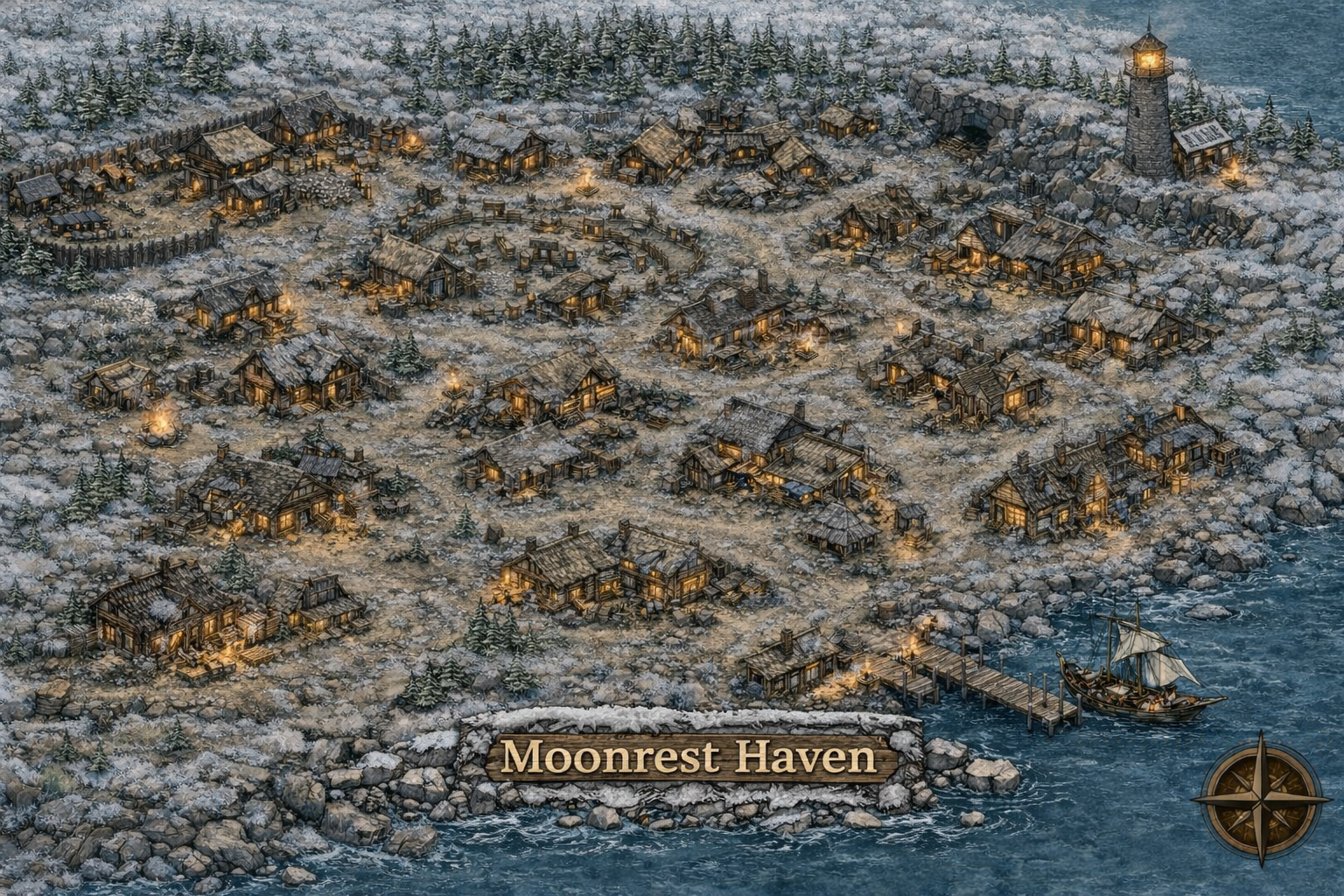
Moonrest Haven
Overview
For a hundred cycles of moon and tide, Moonrest Haven has endured beneath the quiet guardianship of The Moonrest Circle. In the age that followed the world’s unbalancing, the isle turned inward, listening not to crowns or creeds, but to wind through leaf and the slow pulse of the earth itself. The Circle taught that survival was a covenant—between people, land, and spirit—and so the Haven learned to live by signs, seasons, and the call of the bell when the balance demanded answering. Forest and shore were tended as sacred trusts, metal was taken only when the land allowed, and old knowledge was preserved as ritual rather than record. Though grief and loss lingered like mist among the roots, Moonrest Haven remained a place of quiet defiance: a sanctuary shaped by patience, reverence, and the belief that when the world was ready to be healed, the isle would not stand alone.
Government
Moonrest Haven is not ruled by crown, council, or code, but guided by The Moonrest Circle, a covenant of stewards who interpret the will of the land and the needs of the people. Authority is exercised through consensus, ritual obligation, and service rather than decree. Decisions of consequence are made in open gathering, where elders, wardens, and oath-bound voices are heard according to experience and responsibility, not lineage or wealth. The ringing of the Haven Bell serves as the closest thing to law—when it calls, all who are able must answer, placing communal survival above personal claim. Justice is restorative, focused on balance and atonement, and leadership within the Circle is temporary, situational, and surrendered once the need has passed. In Moonrest Haven, governance is not a position to be held, but a duty to be borne when the land and its people require it.
Defenses
Moonrest Haven is defended not by towering fortifications, but by foresight, vigilance, and covenant with the land itself. Natural barriers—jagged reefs, shifting shoals, dense forest, and mist-laden high ground—are carefully maintained and ritually marked, guiding the welcomed safely ashore while confounding the unwary. The Haven’s true protection lies in its people: wardens trained to move unseen through wood and tide, bell-responders bound by oath to act without hesitation, and Circle rites that awaken ancient wards when balance is threatened. Weapons are few, metal scarcer still, but every defense is deliberate—alarms carved into driftwood posts, paths that mislead rather than bar, and sanctified ground where hostile intent falters. Those who would strike Moonrest rarely realize they are under watch until the land itself decides they have gone no further.
Currency Assumptions
- Copper (cp): Everyday trade, food, simple goods
- Silver (sp): Favors, skilled labor, decent tools
- Gold (gp): Rare; usually relic coinage or foreign minting
- Barter is preferred; coin often adds a bonus rather than replacing trade
Age Distribution
Moonrest skews older than many settlements, reflecting caution, low birth rates, and hard survival years.
- Children (0–12): 121 (15%)
- Adolescents (13–18): 73 (9%)
- • Adults (19–45): 309 (38%)
- • Elders (46–70): 243 (30%)
- • Very Elderly (71+): 66 (8%)
Elders are culturally significant; age is associated with wisdom and spiritual authority rather than frailty.
Lineage & Origin
Moonrest’s identity is rooted in continuity, but shaped by selective refuge.
• Island-Born Lineages: 493 (61%)
○ Families tracing ancestry back before the calamities
• Refugees & Outsiders: 229 (28%)
○ Arrived over decades by shipwreck, exile, or pilgrimage
• Descendants of Fallen Empires: 90 (11%)
○ Often absorbed quietly; surnames and histories softened over time
Ancestry Breakdown
- Humans — 402 (49.5%)
- Halflings — 126 (15.5%)
- Elves — 88 (10.8%)
- Dwarves — 74 (9.1%)
- Gnomes — 47 (5.8%)
- Half-Orcs — 41 (5.0%)
- Other Ancestries — 34 (4.3%)
- Leshy — 14
- Athamaru — 9
- Catfolk — 6
- Kitsune — 4
- Anadi — 1
- Leshy — 14
No comments to display
No comments to display